OLED vs LCD: What's the Difference? The Complete Guide Before Replacing Your Phone Screen
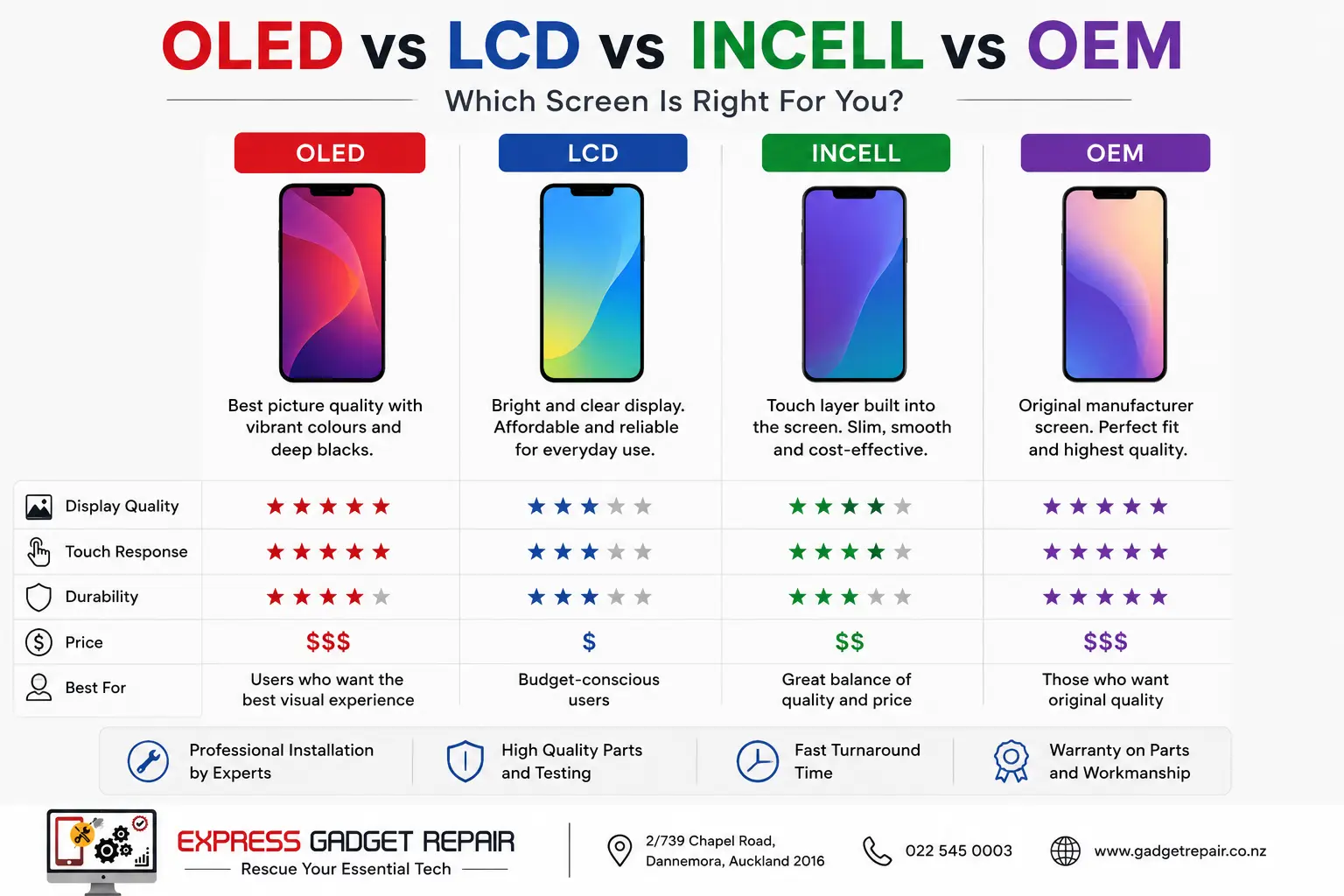
Dropping your smartphone is something almost everyone experiences at some point. Whether you own an iPhone, Samsung Galaxy,Huawei , Google Pixel, or another premium smartphone, a cracked screen is one of the most common repairs. Once you visit Gadget Repair, you'll often hear two terms—OLED and LCD.
Many customers ask us, "What's the difference between OLED and LCD?" or "Which screen should I choose?" If you're unsure, you're not alone. Understanding the differences between these two display technologies can help you make the right decision based on your budget, expectations, and how you use your phone.
At Express Gadget Repair, we believe customers should understand their repair options before making a decision. This guide explains everything you need to know about OLED and LCD displays.
What Is an OLED Display?
OLED stands for Organic Light Emitting Diode.
Unlike traditional displays, every individual pixel produces its own light. This means OLED screens don't require a separate backlight. Each pixel can turn completely on or off independently.
Because of this technology, OLED displays produce:
- True black colours
- Incredible contrast
- Rich, vibrant colours
- Better viewing angles
- Faster response times
- Improved energy efficiency when displaying darker colours
Most premium smartphones now use OLED technology because of its superior picture quality.
What Is an LCD Display?
LCD stands for Liquid Crystal Display.
Instead of each pixel producing its own light, LCD screens rely on a separate LED backlight positioned behind the display. The liquid crystals control how much light passes through to create the image.
LCD technology has been around for many years and continues to provide reliable performance at a more affordable cost.
Many older smartphones and budget devices still use LCD displays.
How Do OLED and LCD Work?
The biggest difference is how light is produced.
OLED
Each pixel lights itself independently.
Black pixels simply switch off completely.
LCD
The entire display is illuminated by a backlight.
Even black areas still have light shining through, making them appear dark grey rather than true black.
This is the reason OLED screens look much richer and more premium.
Picture Quality
When comparing image quality, OLED is generally considered the better display technology.
OLED displays offer:
- Higher contrast ratios
- More realistic colours
- Better HDR performance
- Deeper blacks
- Sharper image quality
- Better outdoor visibility
LCD screens still produce bright and clear images, but they cannot reproduce the same depth of colour as OLED.
If you watch videos, edit photos, or play games regularly, OLED provides a noticeably better experience.
Brightness
Many people assume OLED is always brighter.
In reality, modern LCD displays can become extremely bright.
However, OLED usually provides:
- Better contrast in sunlight
- Improved visibility
- More accurate colour reproduction
For everyday users, both displays perform well outdoors.
Battery Life
One advantage of OLED is energy efficiency.
Because black pixels switch off completely, OLED uses less power when displaying dark colours.
This is why many phones now include Dark Mode.
LCD screens keep the entire backlight active regardless of what appears on the display.
However, battery life also depends on:
- Screen brightness
- Apps
- Processor
- Battery health
The display is only one part of overall power consumption.
Durability
Many people believe OLED screens are stronger than LCD screens.
The truth is both displays can crack if dropped.
Neither display technology makes your phone more resistant to impacts.
Protection depends on:
- Phone case
- Screen protector
- Drop height
- Surface impact
Using a quality case and tempered glass protector remains the best way to protect either display.
Touch Performance
Both OLED and LCD replacement screens provide excellent touchscreen performance when installed correctly.
Professional repair shops carefully calibrate the display to ensure:
- Accurate touch response
- Smooth scrolling
- Responsive gestures
- Reliable performance
Poor-quality replacement screens may reduce touch sensitivity, regardless of whether they are OLED or LCD.
Repair Costs
One of the biggest differences between OLED and LCD is cost.
OLED Replacement
Usually costs more because:
- Higher manufacturing costs
- Premium display technology
- Better image quality
LCD Replacement
Usually costs less because:
- Simpler manufacturing
- More affordable components
- Lower replacement costs
For many customers, budget plays an important role when choosing a replacement display.
Which Display Looks Better?
If image quality is your priority, OLED is the clear winner.
Advantages include:
✔ True blacks
✔ Better colours
✔ Better contrast
✔ Smoother animations
✔ Premium viewing experience
LCD remains an excellent choice for customers wanting a reliable repair while keeping costs lower.
Which One Should You Choose?
Choose OLED if:
- You want original display quality.
- You watch lots of videos.
- You play mobile games.
- You edit photos.
- You prefer richer colours.
- You want the closest experience to your factory screen.
Choose LCD if:
- You want a more affordable repair.
- Your phone is older.
- You mainly use your phone for calls, browsing, and messaging.
- You're looking for excellent value.
Why Professional Installation Matters
Even the best replacement screen can perform poorly if installed incorrectly.
Professional repair technicians ensure:
- Correct adhesive installation
- Proper waterproof seals where applicable
- Display calibration
- Face ID and sensor alignment
- Thorough testing
Choosing an experienced repair shop helps ensure your replacement screen performs as expected.
Tips to Protect Your New Screen
After replacing your display:
- Install a tempered glass screen protector.
- Use a shock-resistant case.
- Avoid placing your phone in the same pocket as keys.
- Keep your phone away from extreme temperatures.
- Avoid sitting on your phone.
- Clean the display with a microfiber cloth.
These simple habits can help extend the life of your replacement screen.
Why Choose Express Gadget Repair?
At Express Gadget Repair, we understand that every customer has different needs and budgets. That's why we explain the available screen options before starting any repair.
Our technicians provide:
- Professional diagnostics
- Premium-quality replacement screens
- Experienced installation
- Competitive pricing
- Fast turnaround
- Comprehensive testing
- Friendly customer service
Whether you choose an OLED or LCD replacement, our goal is to restore your device to excellent working condition.
Frequently Asked Questions
Is OLED better than LCD?
OLED generally provides better colour accuracy, contrast, and viewing angles, while LCD offers a more affordable replacement option.
Can I replace an OLED screen with an LCD?
For some compatible models, yes. Your technician can advise which options are available.
Does OLED improve battery life?
OLED can be more energy efficient when displaying dark content, particularly if you use Dark Mode.
Is LCD still good?
Absolutely. Modern LCD displays offer excellent brightness, sharpness, and reliability, making them a popular choice for budget-conscious repairs.
Final Thoughts
Choosing between OLED and LCD depends on your priorities. If you want the highest-quality display with vibrant colours, deep blacks, and excellent contrast, OLED is the premium choice. If you're looking for a cost-effective repair that still provides reliable everyday performance, LCD is an excellent option.
At Express Gadget Repair, we help customers make informed decisions based on their device, budget, and expectations. Whether you need a screen replacement, battery replacement, charging port repair, or another repair, our experienced technicians are ready to help.
If you're unsure which screen is right for your phone, contact Express Gadget Repair today for expert advice and professional repair services in Auckland.


